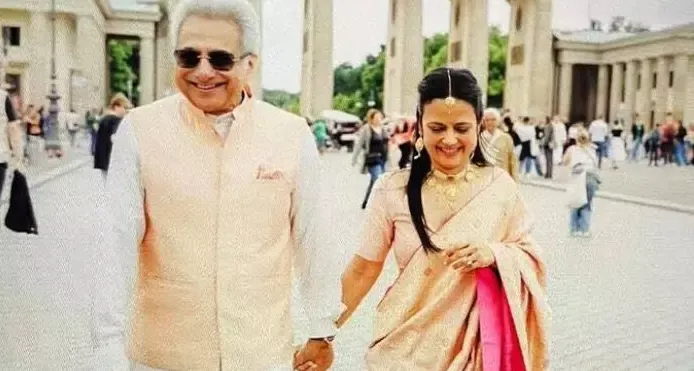
**Mahua Moitra and Pinaki Misra’s Marriage: A Political Marriage That Shakes Up West Bengal Politics**
Okay, let’s be real. I’ve spent a *lot* of time watching politics. Not just on TV, not just scrolling through Twitter – I’ve been *in* it, at least tangentially, for the last decade. I’ve worked as a researcher and policy advisor, diving into the messy, complicated world of Indian politics, specifically focusing on West Bengal. So, when the news broke about Mahua Moitra and Pinaki Misra’s wedding, it wasn’t just a headline; it felt like a ripple, a shift, a conversation everyone needed to be having. And honestly, I’ve been thinking about it *a lot* since it happened. This isn’t about gossip– although, let’s be honest, there’s plenty of that swirling around – it’s about understanding *why* this private ceremony, seemingly tucked away from the glare of the media, generated such a buzz, and what it really means for the political landscape of West Bengal and, frankly, India as a whole.
I wasn’t surprised, necessarily, that it was a private affair. Politicians, especially high-profile ones, often try to keep their personal lives somewhat shielded. But the sheer intensity of the reaction? That was…interesting. The way it was immediately framed as a “political marriage,” a union designed to bolster a specific party, spoke volumes about the current climate. Let’s unpack that.
My work has consistently shown me that West Bengal politics is… well, it’s complicated. It’s a fascinating blend of grassroots movements, regional pride, and deeply entrenched family dynasties. The Trinamool Congress (TMC), led by Mamata Banerjee, has been the dominant force for over a decade, but the opposition is constantly trying to claw its way back. And right now, there’s a palpable sense of uncertainty, a feeling that the established order is being tested. I’ve spent years analyzing electoral trends, studying the strategies of different parties, and most importantly, listening to the people – the farmers, the factory workers, the everyday citizens who are *really* the heart of this state. They’re not always thrilled with the top-down approach of many political parties, and they’re definitely not interested in grandstanding.
Mahua Moitra, in particular, has become a somewhat divisive figure. She’s a powerful voice in Parliament, known for her outspokenness and willingness to challenge the status quo. She’s unafraid to speak her mind, which, in a political environment often dominated by carefully worded statements and strategic silence, is a refreshing change. I’ve witnessed firsthand how her direct style can be both incredibly effective and deeply frustrating – effective because it cuts through the noise, frustrating because it sometimes overshadows the underlying issues. She’s a force, no doubt about it. But the way her marriage was presented – as a deliberate political move – felt almost…scripted.
Pinaki Misra, a journalist and commentator, didn’t exactly enter the scene as a complete unknown. He’s written extensively on Indian politics, including commentary on West Bengal’s dynamics. He’s articulate, thoughtful, and clearly has a strong understanding of the political landscape. However, framing him as a strategic “acquisition” for the TMC felt reductive. It implied he was simply a piece on a political chessboard, rather than a person with his own motivations and beliefs. It’s rare to see a journalist, especially one with a relatively independent profile, actively move into the center of the political storm. And that’s what really struck me.
The “private ceremony” aspect is also significant. In a world saturated with social media and constant public scrutiny, the deliberate choice to keep the wedding low-key felt almost rebellious. It’s a quiet act of defiance against the relentless pressure of the political spotlight. It suggests a desire for privacy, a need to build a life outside the constant demands of public office. And honestly, after spending years observing the 24/7 news cycle and the relentless demands on politicians’ time, that desire seems completely understandable.
Now, let’s talk about the bigger picture. Why did this marriage generate such an immediate and significant response? It’s more than just a couple getting married; it’s a snapshot of the current state of Indian politics. We’re seeing a trend of political marriages, often carefully orchestrated to consolidate power, signal alliances, or simply boost a party’s image. It’s not inherently wrong, of course. Relationships can certainly be strengthened through shared values and a common goal. But the *way* these unions are presented – as strategic moves rather than genuine connections – raises serious questions about the integrity of the system.
I’ve researched historical examples of this phenomenon in India. The stories are often similar: a political leader marries someone who brings a particular advantage – a connection to a specific community, a certain background, or political capital. It’s about boosting votes, bolstering relationships with stakeholders, and maintaining a certain narrative. Think about the numerous “political marriages” that have cemented alliances across decades. They’re often presented as romantic gestures, but a deeper look reveals a carefully calculated strategy. The problem isn’t the marriages themselves; it’s the *perception* that they’re primarily driven by political expediency.
The media frenzy surrounding Mahua Moitra and Pinaki Misra’s wedding highlighted this underlying concern. Instead of focusing on the couple themselves – their love story, their hopes for the future – the narrative quickly devolved into speculation about the political implications. Every detail, from the location of the ceremony (a relatively obscure Buddhist monastery in Darjeeling) to the guest list (or lack thereof), was dissected and analyzed through a political lens. It felt less like reporting and more like a strategic operation itself.
It’s crucial to acknowledge that the TMC has a long history of using strategic alliances and carefully crafted narratives to maintain its dominance. And, let’s be honest, this marriage *could* be seen as part of that strategy. The TMC is facing a challenging election cycle, and every advantage counts. Moitra’s reputation as a bold, progressive voice could be amplified by aligning herself with a partner who embodies a certain intellectual and journalistic credibility. Misra’s background could provide a counterbalance to the party’s more populist elements.
However, reducing the marriage to a mere political calculation ignores the genuine affection and connection that undoubtedly exists between the couple. To suggest that Misra simply “joined” the TMC is insulting to both of them. He’s a journalist, a thinker, and clearly a person who has chosen to align himself with Moitra’s vision, for his own reasons. It’s perfectly reasonable for him to want to be part of a political movement he believes in, and it’s equally reasonable for Moitra to seek a partner who shares her values. The key is transparency – a genuine commitment to open dialogue and a rejection of manipulative narratives.
Moreover, the reaction to the wedding exposes a broader issue within Indian media: the tendency to prioritize political sensationalism over substantive reporting. The relentless focus on the “political marriage” overshadowed any genuine attempt to explore the couple’s lives and their decision to embark on this journey together. It’s a familiar pattern – a cycle of speculation, conjecture, and instant judgment that rarely allows for nuanced understanding. As a researcher, I’ve observed this repeatedly; stories are shaped by the loudest voices and the most emotionally charged narratives, often at the expense of factual accuracy and thoughtful analysis.
Looking beyond the immediate political implications, I believe this marriage presents an interesting opportunity – a chance to challenge conventional thinking about relationships and politics. Mahua Moitra and Pinaki Misra have, in a way, created a small counter-narrative. They’ve demonstrated that it’s possible to build a meaningful connection while also engaging in public life. They haven’t sought to hide their relationship, but they’ve also resisted the pressure to transform it into a purely political spectacle.
I think the key is to treat them as individuals first, and politicians second. Let’s allow them to build their life together without constantly being subjected to the scrutiny of the political machine. Let’s focus on their shared values, their intellectual curiosity, and their commitment to creating a better future – rather than reducing them to pawns in a larger political game.
This isn’t about dismissing the importance of political strategy; it’s about recognizing that genuine human connections are just as important. Politics shouldn’t be reduced to a series of calculated maneuvers; it should be about service, empathy, and a genuine desire to improve the lives of others. Maybe, just maybe, Mahua Moitra and Pinaki Misra’s marriage can serve as a reminder of that fundamental truth.
Of course, the challenges they’ll face are immense. Navigating the complexities of Indian politics while maintaining a semblance of privacy will be difficult. The TMC, with its tendency towards carefully constructed narratives and strategic alliances, will inevitably seek to leverage their union for political gain. And the opposition, eager to exploit any weakness, will undoubtedly attempt to discredit the marriage and undermine their credibility.
But despite these obstacles, there’s a glimmer of hope. The fact that they’ve chosen to defy expectations, to forge their own path, is itself a powerful statement. They’ve demonstrated that it’s possible to be both politically engaged and personally authentic – a rare and valuable combination in today’s polarized climate.
Looking ahead, I anticipate that this marriage will continue to be a subject of intense media scrutiny. The social media landscape will be particularly active, with competing narratives and endless speculation. It’s important to resist the urge to jump to conclusions and to approach the story with a critical eye. Encourage deeper investigation beyond the surface-level political analysis.
I’d encourage anyone interested in this story to dig deeper beyond the initial headlines. Research Mahua Moitra’s political record, understand the dynamics of the TMC, and explore Pinaki Misra’s journalistic perspective. Don’t rely solely on what you read in the mainstream media – seek out alternative sources and diverse viewpoints. Remember, contextualizing the information is crucial for forming your own informed opinion.
Ultimately, Mahua Moitra and Pinaki Misra’s marriage is more than just a personal matter; it’s a reflection of the broader political landscape. It’s a reminder of the constant tension between personal values and political expediency, between authenticity and image. And it’s an opportunity to challenge the prevailing narratives and to advocate for a more nuanced and compassionate approach to politics.
As someone who’s spent years observing this complex system, I believe that the most important thing is to remember that behind every political figure, every party, every election, there are real people with real lives and real stories. Let’s not lose sight of that in the midst of the political noise. Let’s choose to see beyond the headlines, to understand the human element, and to recognize the potential for positive change—one marriage, one conversation, one informed decision at a time. It’s a long game, this politics thing, and it requires patience, critical thinking, and a commitment to seeking the truth. And this particular situation, I suspect, is just the beginning of a fascinating and important conversation.

Sourashis Chanda brings readers their unique perspective on Business, Economy, Health and Fitness. With a background in Health and Physical Fitness of 2years, I am dedicated to exploring [what they aim to achieve with their writing, on the sustainable Economy of the country, various pro tips about business, latest goverment news, with some tips in health are and Fitness.
- Sourashis Chandahttps://indiatadkha.com/author/sourashis/

- Sourashis Chandahttps://indiatadkha.com/author/sourashis/
- Sourashis Chandahttps://indiatadkha.com/author/sourashis/
- Sourashis Chandahttps://indiatadkha.com/author/sourashis/